
Hull Form Selection for Small High-Speed Commercial Vessels
1.1 Introduction
One of the most common and fundamental questions we get asked, especially in small craft, is along the lines of, “What’s the best hull form for a boat designed for application xxx?”
The first thing I’d like to emphasise is that this article is about a question; I didn’t say we’d answer it. Its impossible to answer that type of question properly without a full set of technical, operational, and commercial requirements, so this is very deliberately a general information article, intended to provide background on the important aspects of the decision. It’s aimed at a reader with general marine or vessel operational knowledge, but without any particular design or engineering background. In that regard the theoretical or technical explanation may not be strictly perfect, but we’re trying to keep it accessible for the reader.
The technical background to this article is a study we carried out several years ago comparing hull types for small rescue boats. We’ve kept that original data as the basis and generalised it to suit small commercial boats in the 6 to 12 metre size range. It’s also written from the perspective of commercial vessel regulations in Australia, namely the National Standard for Commercial Vessels (NSCV), enforced by our national regulator, AMSA. National regulations like these vary the world over, but similar design drivers are likely to apply in other countries.
1.2 The Contenders
Our original study used rescue boat platforms around eight metres in length overall. The aim was to select vessel dimensions that were reasonably equivalent in load carrying and general capacity, so that a representative comparison could be made. We used our own design data where we could, and where that wasn’t available we drew on published information, such as magazine articles, to fill the gaps.
Because this comparison was originally produced to compare patrol and rescue boats, comparative differences may change if another vessel use type was selected for investigation. That being said, a rescue or patrol boat of this size in Australia is in many ways well suited to use as a general purpose workboat, in coastal or restricted offshore waters.
| Particulars | 8.5 m RHIB | 8.3 m Mono | 7.5 m Cat | 8.0 m Tri-Hull |
|---|---|---|---|---|
| Hull Length (m) | 8.50 | 8.30 | 7.50 | 8.00 |
| Beam (m) | 3.10 | 2.70 | 2.60 | 2.70 |
| Half Load Displ. (t) | 3.33 | 3.13 | 3.43 | 3.13 |
| Installed Power (hp) | 400 | 400 | 400 | 400 |
| Max. Speed (kn) | 44.5 | 45.0 | 39.0 | 40.0 |
2.0 Technical Criteria Explained
2.1 Ride comfort
Ride comfort is a critical factor for patrol and rescue boats, and in our study it was assessed against vertical acceleration calculated to classification society rules. These rules don’t account for every design feature that could affect vertical accelerations, but they do represent the distilled knowledge of expert certifying organisations gathered over many decades, and provide a sound basic measure of vessel accelerations and ride comfort. Its also a measure of the ability to maintain speed in a given seastate.
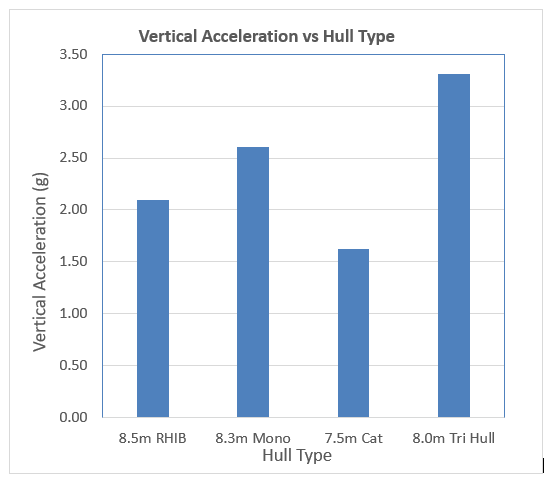
Vertical Acceleration (ride comfort)
The main inputs to the calculation are:
· Chine Beam
· Effective Deadrise Angle
· Displacement
· Speed and
· Significant Wave Height
The output is the average of the 100 highest accelerations at the given vessel speed and wave height. It effectively models a wave impact slam, where a section of the boat rises out of the water and then lands hard enough to be immersed again to the full bottom width, or chine beam.
Importantly, the deadrise angle used here isn’t the term most non-naval architects would recognise, which is simply the angle of the bottom plate from horizontal. The formula uses the effective deadrise angle, measured from the keel to the outer chine. In layman’s terms, in a landing the chines turn the water that has been pushed out and up from the V-bottom back into a downward direction, which adds greatly to the vertical forces and structural loads.
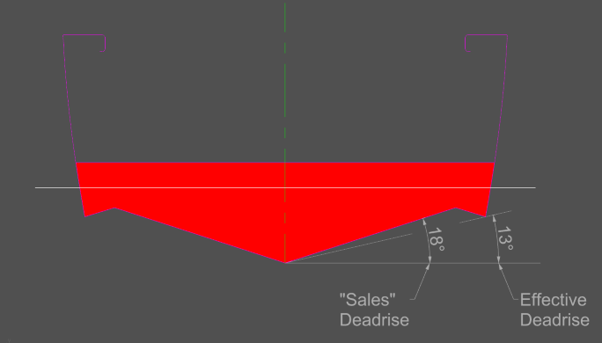
Effective Deadrise Angle
The effective deadrise angle is also measured at the boat’s centre of gravity, so it tends to average the deadrise along the length of the hull while also accounting for the effect of the chines.
Ride comfort isn’t important only for rescue vessels. Any small craft operating in anything other than flat calm conditions will be subject to significant motions, purely due to scale effects. It matters for operability and crew fatigue, and is especially important for passenger vessels, where it may be decisive.
How each hull performed is explained further in the relevant section, but note in particular that the catamaran could have performed significantly better than shown below, with a relatively small change to demi-hull beam. Our catamaran designs generally carry slightly more demi-hull beam to provide greater safety factors for stability and controllability in following seas.
It’s also worth noting that the human body is highly sensitive to vertical accelerations, so a difference of, say, 25% between alternatives (for example between the RHIB and the monohull) would feel markedly different in operation.
2.2 Seakeeping
Seakeeping broadly covers the whole range of factors that describe how a boat handles underway at sea. Ride comfort, or vertical acceleration, is really a subset of seakeeping, but we’ve separated it out here to highlight its importance in small craft.
Other aspects of seakeeping include directional stability, steering control and course keeping, dynamic stability, and other types of wave impact and their effects. It’s a large topic and far too complex to cover in any depth here, so we’ll highlight particular aspects most relevant to each hull type in the detailed sections that follow.
2.3 Static Stability
Static stability refers to a vessel’s stability, or resistance to capsizing, when at rest. There are speed-related effects on stability, especially in the planing mode, which increase with vessel speed. At displacement speeds, however, those effects are virtually nil, and in practise it’s static stability that’s almost always used to assess compliance with regulations.
Righting arm, or righting lever, is one of the most important measures of vessel stability, if not the most important. It is a measure of the force required to heel the vessel to a given angle. We’ve presented righting curves for each hull type. Note that these curves haven’t been corrected for effects of water ingress into the cockpit, whether through scuppers or over the gunwale.
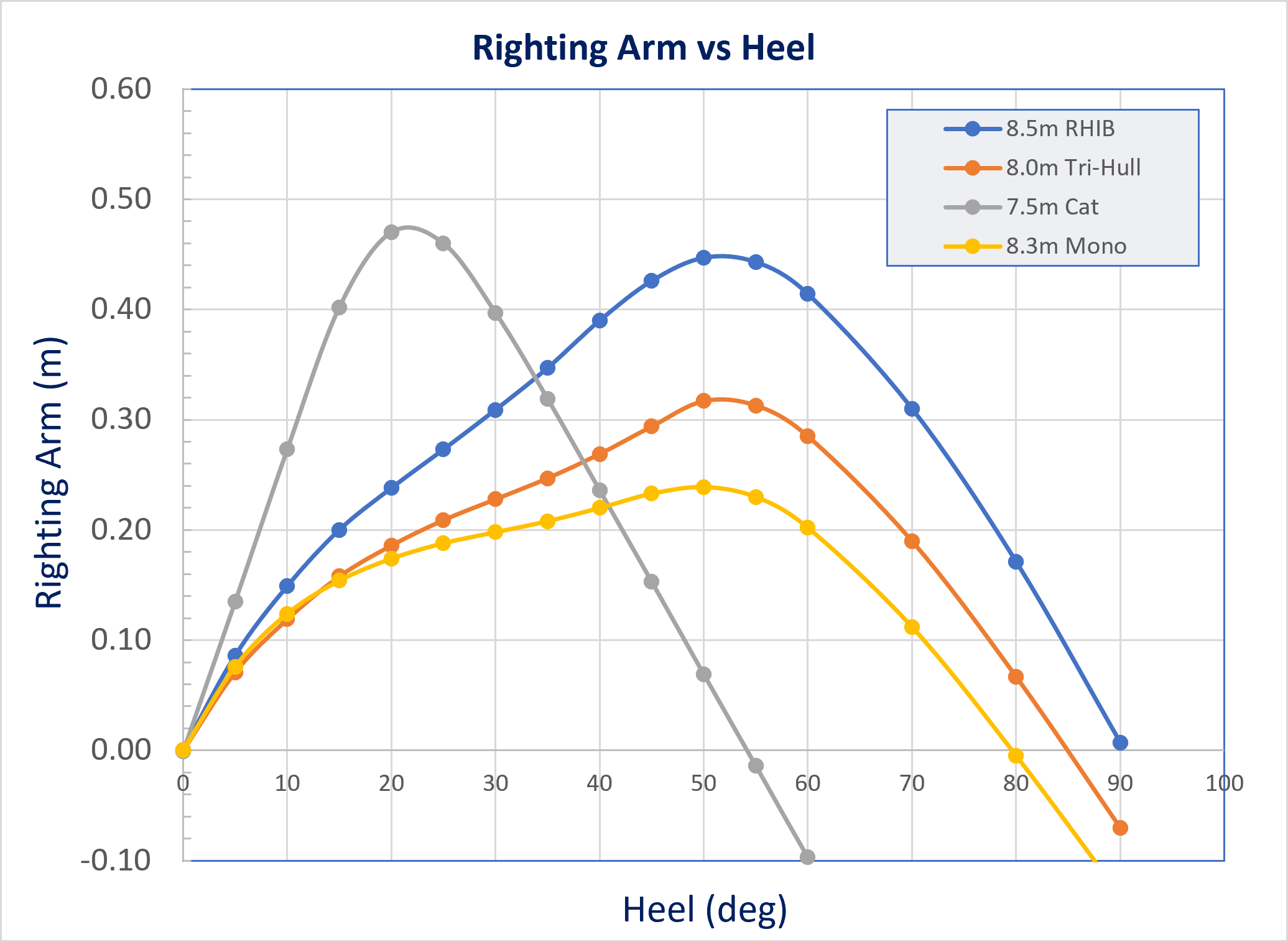
A vessel with a very steep righting arm curve, like the catamaran, will feel very stiff at rest and subjectively very stable. It tends to ‘contour’ with the wave profile, so that the deck line closely follows the wave slope. The trade-off is that the motions tend to be quick, and a vessel that is too stiff can in fact become uncomfortable over long periods.
In vessels with very high initial stability, the curve also tends to taper-off quickly after reaching an early peak value. While the excellent initial stability is valuable, the narrower peaked curve, and generally low heel angles seen in normal operations can disguise, or mask from the operator how close to the limits of stability the boat is actually being operated.
Conversely, vessels with a flatter righting arm are more sensitive to weight movement from side to side, but have a smoother motion in roll. They also tend to have a larger overall range of stability and the transition through the peak to eventual loss of stability is more progressive. This provides a better seat-of-pants warning to the operator of stability limits.
An important point to note is that the NSCV stability requirements for vessels of this size revolve around low-angle, or initial, stability. This means there are strong advantages in having a righting arm curve that is relatively steep early on. Stability at larger angles is rarely a major factor for rule compliance, but that doesn’t mean it should be ignored, especially for particular vessels such as rescue boats or vessels used for towing.
For reference, stability regulations applicable to larger craft in severe or storm/survival weather generally put greater emphasis on the area under the righting arm curve, as a measure of the total energy required to capsize the vessel.
2.4 Powering
The plot below shows the maximum speed achievable for each option, which is important for patrol and rescue boats, but less so for other uses. Each hull type has different characteristics at different speeds, which we’ll explore further on in the article.
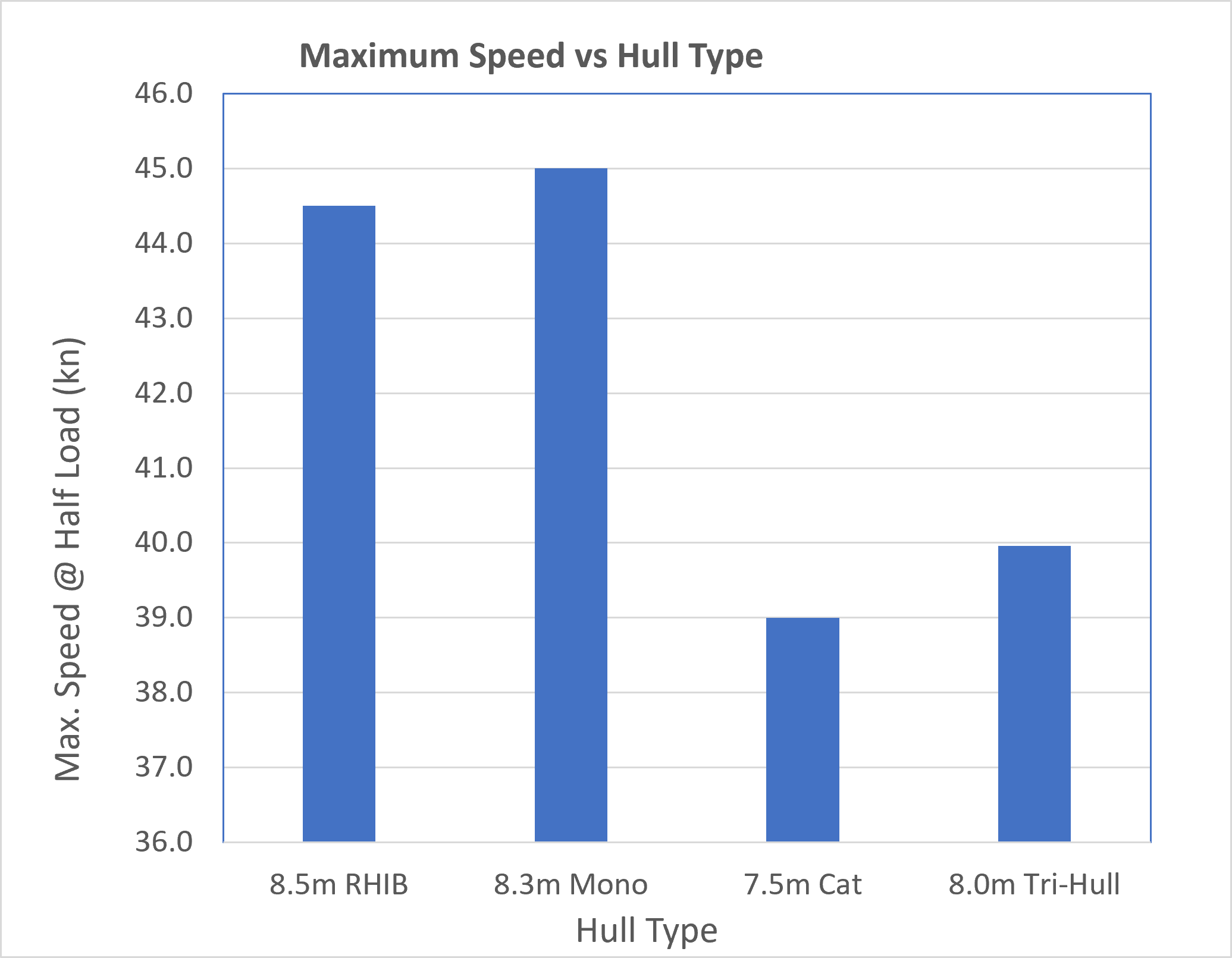
Note: Same installed power used for each
3.0 Hull Form Characteristics
Monohulls
The hull form we chose for this example is a derivative of one of our deep-vee recreational designs, modified as required to meet commercial vessel stability requirements. While it trails the RIB in ride quality, it still performs reasonably well by comparison. This picture would start to change fairly quickly if, for example, more passengers were carried or a larger superstructure with more windage was added. To maintain stability, the deck height has to be raised further above the water, or the bottom deadrise angle reduced. Alternatively or in combination, the beam may be increased, none of which help ride quality.
The monohull shows the best result in this comparison for maximum speed, although this is rarely a strong selection factor for most commercial vessels. In relative efficiency terms the monohull is ahead of the RIB, and well ahead of the cat, at more moderate speeds. At speeds under 20 knots the tri-hull comes into its own, with good fuel efficiency and load carrying capability.
Static stability under normal operations is the ‘worst’ of this group, which isn’t an unexpected result given the regulations’ emphasis on low-angle stability. Considered more holistically, however, and particularly under extreme conditions, the range of stability can be very good if attention is paid to downflooding points and immersion angles. Cockpit coaming immersion at around 60 degrees of heel is achievable.
Monohulls have historically been favoured as rescue boats over any of the multihull types. A well designed conventional monohull should show good all-round seakeeping in rough conditions, with no inherent flaws or areas of concern.
In short, the monohull is the all-rounder of this group. Its main drawback is the low-angle stability, which tends to make life more difficult for passenger vessel use, and for any application carrying a significant amount of cargo on deck (or lifting).
RIBs
The excellent ride quality of the RIB comes from the combination of a relatively narrow chine beam, and a large effective deadrise angle. The sponsons or collars provide the necessary stability at rest, and make level flotation virtually an inherent part of the package.
Combined with a well designed bow shape, the RIB offers secure, safe handling on all headings, and is virtually unchallenged worldwide as the go-to rescue boat in this size range.
This inherently good seakeeping and safety also make it a worthwhile general purpose workboat in offshore conditions. For passenger operations, the level flotation design means that the weight, space and maintenance requirement for carrying a life raft is avoided under NSCV Code.
The drawbacks are the space taken up by the sponsons and the additional build and maintenance costs, which can be significant depending on the type and materials chosen. These can be mitigated or optimised to an extent, but there will always be some additional cost.
A further cost and potential maintenance issue arises from the level flotation design, which requires foam to be fitted below decks. This can largely be mitigated through attention to detail during design and installation: considering where water could become trapped, minimising surface contact with the aluminium, and allowing for ventilation and inspection.
The RIB is capable of carrying heavier loads, but a catamaran or tri-hull would be a more likely candidate for that depending on the load, speed, and other vessel requirements.
Catamarans
In terms of ride quality, the catamaran is the magic carpet of this group. A common myth (mostly heard in pleasure boat circles) is that the planing catamaran’s ride quality has something to do with aerodynamic lift, bubbles of air, or compressed air in the tunnel. The actual physics are much simpler: the combined beam of the two catamaran hulls is much narrower than the chine beam of an equivalent monohull. It is this reduced bottom, or landing area, that reduces impact loads, even with moderate deadrise, and delivers a ride quality in head seas that is virtually impossible to match.
The rectangular footprint of the catamaran provides excellent stability at rest, with a very steep righting arm curve. This makes it an excellent candidate for load carrying, particularly for passenger vessels and wherever lifting is required. It is also good for towing (up to a point), and the wide separation of the engines gives excellent manoeuvrability in tight confines for general workboat duties.
The potential drawbacks are that ride quality depends on ride height, so the vessel needs to run ‘lifted’ at planing speed to keep the tunnel between the hulls clear of wave impacts. As speed drops the ride quality deteriorates, and at displacement speed the waterplane becomes effectively a large rectangle. This can be uncomfortable, and progress can be difficult in the worst head sea conditions. It can also make anchoring difficult in exposed locations.
The catamaran has the lowest sprint speed in the group, and generally requires more power across the speed range. The difference varies with speed, but a representative figure is around 25%.
The planing catamaran hullform can also exhibit poor handling in wave directions from beam-on to following seas, depending on the design characteristics and the sea conditions. This behaviour has variously been described as bow diving, bow tripping, and broaching, and in the most serious cases can result in vessel capsize. It is crucial to note, however, that this behaviour is almost entirely preventable through good design, in all but the worst sea conditions. I raise the issue to inform discussion, rather than to suggest any inherent problem with catamarans.
Monohulls with overly fine, deep bow shapes can also be prone to broaching. The difference with a catamaran is that the hulls are naturally more fine and deep to begin with, so the effects are amplified, and attention to bow shape and overall slenderness is critical for vessels intended to be used offshore.
Our view, in a like-for-like comparison, is that a RIB is still preferable over a catamaran for a rescue boat duty in severe weather and large waves. That does not mean we would not recommend a catamaran where there is effectively a cap on maximum wave height, such as in a bay or other partly protected waters.
Tri-hulls
The tri-hull, or cathedral hull is essentially a type of improved low-deadrise monohull. In concept, the angled bottom surfaces provide a softer initial impact in relatively benign sea conditions. In moderate sea states and above, however, where full bottom slams occur, the ride deteriorates rapidly. This is largely because in cross section, the effective deadrise angle is generally quite low from the centreline to the lowest point of the outer sponson or hull. A number of platforms are available with different features and tunnel heights between the hulls, but the overall principles remain the same.
This hull form is notable for achieving a planing attitude at very low speeds, and for efficient load carrying at low to medium planing speeds. As speeds increase, the large wetted surface tends to hinder efficiency and performance tails off, which is reflected in one of the lower maximum speeds of the hulls investigated.
The stability characteristics are very good, and arguably easier to ‘tune’ than those of a conventional monohull. It is well suited to general purpose workboat duties in more protected waters, particularly for load carrying, and potentially for lifting applications.
4.0 Concluding Remarks
As we noted at the outset, this article set out to explore a question rather than to answer it in any definitive way. The reason is straightforward: there is no single best hull form, only the hull form best matched to a defined set of operational and commercial requirements. The monohull, the RIB, the catamaran and the tri-hull each carry an inherent balance of ride comfort, seakeeping, stability, powering and load carrying. Improving one of these almost always comes at the expense of another, and it is the way these trade-offs are weighted against the operational priorities that ultimately points to the right choice.
The comparison presented here was deliberately framed around equivalent patrol and rescue platforms, and the conclusions shift as soon as the design brief changes. A vessel optimised for passenger comfort in protected waters, for towing, or for carrying cargo on deck will favour a different balance again. The value of an exercise like this lies less in the numbers themselves than in gaining an understanding of why each hull behaves as it does. A buyer or decision maker that’s informed can drive a much better outcome from that position of knowledge.
We hope this article has offered a useful window into how we think about some of these bigger decisions, and into the design judgement and experience that sits behind every recommendation we make.